Legal & Privacy
USDXM Whitepaper
|
No. |
FIELD |
CONTENT |
|||
|
I.00 |
Table of content |
I.01 Date of notification I.02 Statement in accordance with Article 51(3) of Regulation (EU) 2023/1114 I.03 Compliance statement in accordance with Article 51(5) of Regulation (EU) 2023/1114 I.04 Warning in accordance with Article 51(4), points (a) and (b) of Regulation (EU) 2023/1114 SUMMARY I.05 Warning in accordance with Article 51(6), second subparagraph of Regulation (EU) 2023/1114s I.06 Characteristics of the crypto-asset I.07 Right of redemption I.08 Key information about the offer and or admission to trading PART F - INFORMATION ON THE RISKS F.1 Issuer-Related Risks F.2 Token-Related Risks F.3 Technology-Related Risks F.4 Mitigation measures PART A - INFORMATION ABOUT THE ISSUER OF THE E-MONEY TOKEN A.1 Statutory Name A.2 Trading name A.3 Legal form A.4 Registered address A.5 Head office A.6 Registration Date A.7 Legal entity identifier A.8 Another identifier required pursuant to applicable law A.9 Contact telephone number A.10 E-mail address A.11 Response Time (Days) A.12 Parent Company A.13 Members of the management body A.14 Business Activity A.15 Parent Company Business Activity A.16 Conflicts of Interest Disclosure A.17 Issuance of other crypto-assets A.18 Activities related to other crypto-assets A.19 Connection between the issuer and the entity running the DLT A.20 Description of the connection between the issuer and the entity running the DLT A.21 Newly Established A.22 Financial condition for the past three years A.23 Financial condition since registration A.24 Exemption from authorisation A.25 E-money Token Authorisation A.26 Authorisation Authority A.27 Persons other than the issuer offering to the public or seeking admission to trading of the e-money token according to Article 51(1), second subparagraph, of Regulation (EU) 2023/1114 A.28 - Reason for offering to the public or seeking admission to trading of the e-money token by persons referred to in Article 51(1), second subparagraph, of Regulation (EU) 2023/1114
PART B - INFORMATION ABOUT THE E-MONEY TOKEN B.1 Name B.2 Abbreviation B.3 Details of all natural or legal persons involved in design and development A DESCRIPTION OF THE CHARACTERISTICS OF THE E-MONEY TOKEN, INCLUDING THE DATA NECESSARY FOR CLASSIFICATION OF THE CRYPTO-ASSET WHITE PAPER IN THE REGISTER REFERRED TO IN ARTICLE 109, AS SPECIFIED IN ACCORDANCE WITH PARAGRAPH 8 OF THAT ARTICLE B.4 Type of white paper B.5 The type of submission B.6 Crypto-assets characteristics B.7 Website of the Issuer B.8 Starting date of offer to the public or admission to trading B.9 Publication Date B.10 Any other services provided by the Issuer B.11 Identifier of operator of the trading program B.12 Language or languages of the white paper B.13 Digital Token Identifier Code used to uniquely identify the crypto-asset or each of the several crypto assets to which the white paper relates, where available B.14 Functionally Fungible Group Digital Token Identifier, where available B.15 Personal data flag B.16 LEI eligibility B.17 Home member state B.18 Host member states
PART C - INFORMATION ABOUT THE OFFER TO THE PUBLIC OF THE E-MONEY TOKEN OR ITS ADMISSION TO TRADING C.1 Public Offering or Trading C.2 Number of units C.3 Trading Platforms name C.4 Trading Platforms Market Identifier Code (MIC) C.5 Applicable law C.6 Competent court
PART D - INFORMATION ON THE RIGHTS AND OBLIGATIONS ATTACHED TO E-MONEY TOKENS D.1 Holder’s rights and Obligations D.2 Conditions of modifications of rights and obligations D.3 Description of the rights of the holders D.4 Rights in implementation of recovery plan D.5 Rights in implementation of redemption plan D.6 Complaint Submission Contact D.7 Complaints Handling Procedures D.8 Dispute Resolution Mechanism D.9 Token Value Protection Schemes D.10 Token Value Protection Schemes Description D.11 Compensation Schemes D.12 Compensation Schemes Description D.13 Applicable law D.14 Competent court
PART E - INFORMATION ON THE UNDERLYING TECHNOLOGY E.1 Distributed ledger technology E.2 Protocols and technical standards E.3 Technology Used E.4 Purchaser’s technical requirements E.5 Consensus Mechanism E.6 Incentive Mechanisms and Applicable Fees E.7 Use of Distributed Ledger Technology E.8 DLT Functionality Description E.9 Audit E.10 Audit outcome
PART G - INFORMATION ON THE SUSTAINABILITY INDICATORS IN RELATION TO ADVERSE IMPACT ON THE CLIMATE AND OTHER ENVIRONMENT-RELATED ADVERSE IMPACTS G.1 Adverse impacts on climate and other environment-related adverse impacts |
|||
|
I.01 |
Date of notification |
This white paper was notified to theNational Bank of Romaniaon 24.12.2024. |
|||
|
I.02 |
Statement in accordance with Article 51(3) of Regulation (EU)2023/1114 |
This e-money token "EMT" white paper "White Paper" has not been approved by any competent authority in any Member State of the European Union "EU". The issuer of the crypto-asset is solely responsible for the content of this crypto-asset White Paper. |
|||
|
I.03 |
Compliance statement in accordance with Article 51(5) of Regulation (EU)2023/1114 |
This White Paper complies with Title IV of Regulation (EU) 2023/1114 (MiCA) and to the best of the knowledge of the management body, the information presented in the White Paper is fair, clear, and not misleading and the White Paper makes no omission likely to affect its import. |
|||
|
I.04 |
Warning in accordance with Article 51(4), points (a) and (b) of Regulation (EU)2023/1114 |
The e-money token USDXM issued by xMoney is not covered by the investor compensation schemes under Directive 97/9/EC. The e-money token USDXM is not covered by the deposit guarantee schemes under Directive 2014/49/EU. |
|||
|
SUMMARY |
|||||
|
I.05 |
Warning in accordance with Article 51(6), second subparagraph of Regulation (EU) 2023/1114s |
This summary should be read as an introduction to the White Paper. The prospective holder should base any decision to purchase USDXM on the content of the White Paper as a whole and not on this summary alone. The offer to the public of USDXM does not constitute an offer or solicitation to
purchase financial instruments and any such offer or solicitation can be made only by means of a prospectus
or other offer documents pursuant to the applicable national law. |
|||
|
I.06 |
Characteristics of the crypto-asset |
USDXM is an electronic-money token (EMT) denominated in and pegged to the USD, issued on the Integrated Blockchains. USDXM is introduced within the European Economic Area (EEA) and is governed in compliance with applicable regulatory frameworks. For every unit of USDXM issued, an equivalent amount in USD is maintained in reserve by xMoney to ensure a 1:1 parity, thereby safeguarding its value and preserving its stability. This USD-backed stablecoin aims to minimize volatility, fostering trust among users seeking a reliable and secure digital asset. |
|||
|
I.07 |
Right of redemption |
The holders of USDXM token have a right of redemption at any time and at par value. The institutional/business holders of USDXM token which are residents of EEA are entitled to exercise their right of redemption if they have successfully registeredwith xMoney by creating an account on its platform. For this category of holders of USDXM token, the redemption is available directly through xMoney via the communication channel agreed between the parties, in maximum 7 days from the request, given that all necessary information was provided by the holders in order for xMoney to respect the regulatory impositions when a redemption request is received. For retail customers redemption, which do not have an account created on xMoney platform, USDXM is listed on multiple cryptocurrency service providers platforms, where the repayment can be requested. Also, retail customers can redeem the USDXM token directly from xMoney according to the Redemption Policy. The detailed description of the conditions of the redemption mechanism can be found in our Redemption Policy: https://xmoney.com/legal |
|||
|
I.08 |
Key information about the offer and/ or admission to trading |
USDXM is an electronic-money (e-money) token issued exclusively by xMoney on the Integrated Blockchains and is accessible through xMoney platform for institutional and business investors operating within the jurisdictions outlined in Section B.18 of this White Paper. Residents of the supported jurisdictions are eligible to acquire USDXM without restriction, regardless of their geographical location at the time of purchase. For retail customers, USDXM is also listed and available to the public with cryptocurrency service providers platforms. USDXM admission to trading is sought on several global regulated crypto asset services providers operating in the EEA, such as Binance, Kraken, Bybit, OKX, MEXC, Gate.io, Bitvavo, Bitpanda. A list including all current cryptocurrency platforms offering USDXM to the public, as well as any future partnerships for trading USDXM, will be publicly disclosed on the official xMoney website xmoney.com/foundry. As typical for stablecoins, xMoney does not have a maximum supply amount of USDXM, which will be determined based on market conditions, driven by demand. xMoney has established a minimum investment requirement of $100,000 for the purchase of USDXM through xMoney platform. For this purpose, xMoney will only accept USD from a bank account held in USD, in the name of the xMoney account holder and only bank accounts within the Single Euro Payments Area (SEPA) are acceptable for transactions. |
|||
|
PARTF - INFORMATION ON THE RISKS |
|||||
|
F.1 |
Issuer- Related Risks |
As the issuer of USDXM, xMoney faces several risks that could compromise the stability of USDXM. These risks include, but are not limited to:
USDXM holders must be aware of the risk that xMoney could face insolvency or bankruptcy due to adverse financial conditions, which could impact its ability to meet obligations and fulfil redemption requests for USDXM. This could result in partial or total loss of funds for token holders.
xMoney relies on third-party service providers, such as credit institutions, to perform essential services for safeguarding and settlement functions. If these third parties fail to deliver, experience operational disruptions, or withdraw support, xMoney’s ability to provide the services related to USDXM may be compromised. Consequently, there may be delays or shortages in the issuance and redemption processes. In addition, USDXM may be listed for purchase by crypto assets service providers on their platforms without necessarily having authorization from xMoney. In such cases, xMoney has no control over the services involving USDXM that will be offered through these third-parties. xMoney disclaims any responsibility or control over third-party platforms that may support USDXM, and explicitly states that it does not guarantee the legality, stability, or suitability of such platforms, and shall not be liable for any losses or issues arising from USDXM holders interactions with such third-party platforms.
In situations of high demand for USDXM redemptions, some reserve assets may not be immediately liquid or may face value fluctuations. This can be a consequence of larger economic and market trends, such as monetary policy changes and investor sentiment. If xMoney is unable to liquidate assets quickly enough, it may face delays in processing redemption requests, affecting USDXM holders' access to funds.
This is the risk that crypto-asset wallets holding USDXM or transactions with USDXM may be used for money laundering or terrorist financing purposes or related to a person known to have committed such offenses.
xMoney collects and processes personal data from its customers. Any failure to protect the personal data from unauthorized access or breaches could lead to data leakage or identity theft.
Operating within a complex regulatory environment, xMoney faces risks associated with non-compliance with evolving laws and regulations across multiple jurisdictions. Changes in regulatory standards or new legal requirements could impose additional operational and financial burdens on xMoney. In line with the provisions of Article 153²⁴ of Company Law no. 31/1990, xMoney mentions that, as of today, its net assets have fallen below 50% of the subscribed share capital. It should also be noted that this accounting imbalance stems from the company’s need to meet its own funds requirements, which over time, has resulted in multiple increases of the share capital, thereby creating a disproportion in relation to the value of its assets. Such situations are frequently met in the Romanian corporate environment. To address this theoretical risk, xMoney has put in place a two-stage plan: Stage I Reduction of share capital by covering accumulated losses as of 31st of December 2024. This step will start during October 2025 and is expected to be completed by December 2025, in line with Article 208(1) of Company Law no. 31/1990, including the creditors’ opposition period. Stage II Reduction of share capital by covering accumulated losses as of 31st of December 2025. This step is expected to be completed in the first half of 2026. By taking these measures, xMoney confirms its commitment to meeting legal requirements and to maintaining the financial stability needed for its operations.
xMoney's ability to maintain robust internal controls is critical to provide sound operations to its customers. Failures or weaknesses in these rules and procedures, whether through oversight or ineffective implementation, could result in errors in providing the services and/or financial losses. 8. Environmental, Social, and Governance (ESG) Risk xMoney`s stablecoin is launched on the Integrated Blockchains, currently supported by a Proof of Stake consensus mechanism. xMoney is committed to supporting sustainable business practices. However, public blockchains used for token transactions vary in energy consumption and environmental impact. If future regulations impose restrictions on high-energy blockchain systems, it could limit the issuer’s ability to issue tokens on certain platforms, impacting its operational flexibility. |
|||
|
F.2 |
Token-Related Risks |
Market Risk is the risk of losses due to unexpected changes in the general market conditions and the exposure of USDXM to multiple crypto assets platforms and wallets might create disruptions and uncertainty.
Even if the nature of the fiat-pegged stablecoins makes them more secure compared with other crypto assets, USDXM market value might fluctuate on the crypto markets due to market dynamics or shifts in supply and demand, potentially leading to slight deviations from the token’s pegged USD value. These price fluctuations may be caused by factors such as reduced liquidity or investor sentiment and may expose USDXM holders to a risk of loss if they sell the token at unfavorable prices.
The USDXM token's value relies on xMoney maintaining reserves sufficient to support redemptions. However, in cases of under-collateralization due to operational issues, fraud, or mismanagement, xMoney may lack the assets needed to fulfill redemption requests. This could delay or prevent redemptions, leading to potential financial losses for token holders.
If there is a high volume of redemption requests, xMoney may face liquidity challenges, particularly if its reserve assets are not quickly convertible to cash. This could result in delays in processing redemptions, affecting USDXM holders' access to funds and potentially leading to price deviations on secondary markets as holders seek alternative means to liquidate their tokens.
This disclosure pertains to the potential risk of loss or damage arising from fraudulent activities perpetrated by malicious third parties against USDXM holders. Such fraudulent activities may include, but are not limited to, phishing schemes conducted through social media platforms or email, fake giveaways or contests, identity theft targeting xMoney or its executive members, the creation and distribution of counterfeit USDXM tokens, and the promotion of fake USDXM airdrops, among other forms of fraudulent behavior.
Regulatory developments or changes in legal requirements may affect the classification, taxation, or treatment of USDXM. As global and EU regulations for digital/crypto assets continue to evolve, future regulatory shifts could impose additional restrictions or obligations on xMoney, impacting USDXM usability, value, or tax treatment for holders. xMoney cannot guarantee that future regulatory changes will not have adverse effects on token holders or the token’s functionality. |
|||
|
F.3 |
Technology- Related Risks |
Notwithstanding the generally reliable performance of most blockchains in terms of execution and uptime, as well as the typically flawless record-keeping capabilities of these networks, the blockchain networks that may face technical vulnerabilities, including potential security breaches due to cyber-attacks or software flaws. These risks could lead to service disruptions, delays in transactions, or a loss of funds for users if malicious actors exploit weaknesses within the blockchain infrastructure (e.g. 51% attacks).
Smart contracts are used to issue, manage, and transfer USDXM on the blockchain. However, coding errors, unexpected system behavior, or software bugs within these smart contracts could result in failed transactions, unauthorized transfers, or potential financial losses for token holders. Upon deployment on a blockchain, the source code of a smart contract becomes publicly accessible and visible to all users and parties. This transparency might enable malicious actors to scrutinize the smart contract's code, identifying potential vulnerabilities or misconfigurations that can be leveraged to launch attacks.
Due to the nature of blockchain technology, transactions are generally irreversible once confirmed. Mistakes in inputting transaction addresses or losing access to private keys could result in permanent loss of funds. Furthermore, there may be no guarantee of retrieving USDXM tokens mistakenly sent to incorrect or unverified blockchain addresses, which could pose financial risks to users.
Blockchain and distributed ledger technology are rapidly evolving, and new vulnerabilities may emerge as cryptographic methods or computing technologies advance. The development of quantum computing poses a potential risk to the security of blockchain systems. Quantum computers could, in theory, break traditional cryptographic algorithms used to secure blockchain transactions, which may compromise the privacy and security of e-money tokens. Unforeseen issues such as changes in consensus protocols, increased network congestion, or the potential need to transition to a different blockchain platform, could impact USDXM operation or security in unexpected ways. |
|||
|
F.4 |
Mitigation measures |
In the event of xMoney’s insolvency or bankruptcy, USDXM holders' rights shall remain unaffected as they are protected by the Applicable law. The reserves of xMoney are safeguarded against other creditors and the USDXM holders will be entitled to their refund rights. As the first electronic money institution in Romania, xMoney is subject to strict regulatory capital and own funds requirements, providing an additional layer of protection for its operations and customers. Additionally, xMoney has established solid Recovery and Redemption Plans designed to address and mitigate any instances of business continuity disruptions. xMoney conducts a rigorous due diligence process when selecting its partners, thoroughly assessing each vendor prior to entering into a cooperation agreement. The vendor selection process is designed with stringent measures to ensure that the services provided are reliable and meet the highest standards of quality and compliance. The contractual clauses in xMoney's agreements are meticulously crafted to ensure the continuity and reliability of service provision, adhering to regulatory requirements and mitigating risks of failure, disruption, or withdrawal of support. The market liquidity concerns are safeguarded by xMoney Redemption Policy, in order to honor the redemption requests. xMoney maintains a zero-tolerance policy toward activities related to money laundering or terrorist financing, strictly adhering to comprehensive AML and CFT risk management frameworks and fully complying with applicable regulatory requirements. Any transactions deemed suspicious are promptly suspended or blocked to ensure compliance and mitigate potential risks. At the same time, xMoney fully complies with GDPR requirements, ensuring the security, confidentiality, and integrity of USDXM holders' personal data, as well as implementing safeguards for all actions related to the processing of such data. To mitigate legal, regulatory, and internal control risks, xMoney has implemented a robust compliance framework designed to monitor and adapt to evolving legal and regulatory requirements. This framework includes internal procedures, continuous regulatory surveillance, and proactive engagement with regulatory authorities to ensure adherence to the applicable laws. xMoney adopts a proactive approach to managing ESG risks, demonstrating a strong commitment to sustainable business practices that minimize environmental impact. This commitment includes promoting responsible resource use and supporting initiatives that reduce its carbon footprint while collaborating with industry experts.
xMoney is committed to regular monitoring of market movements and establishing partnerships with reputable crypto assets platforms and wallets with strong security measures that enhance resilience in uncertain market conditions or price volatility. The volatility of the market is influenced by the actions of market participants, and xMoney may partner with market makers to enhance USDXM liquidity. Furthermore, the Recovery and Redemption Plans, as established, will serve as protective measures for USDXM holders, ensuring their interests are safeguarded in the event of market instability. The risk of under-collateralization is mitigated through the measures provided in the Recovery Plan and Redemption Plan, by strengthening xMoney capital positions. The liquidity risks are simultaneously addressed under the Redemption Plan, which includes prompt responses to unforeseen or high-demand market conditions. xMoney commits to keeping its customers informed about identified scam attempts but it cannot prevent all the fraudulent activities related to USDXM. In this regard, xMoney cannot be held liable for any losses incurred due to such scams or fraud. USDXM holders shall acknowledge that xMoney does not provide legal or tax advice in relation to USDXM. Any taxation obligations associated with USDXM are the sole responsibility of the USDXM holders. It is the duty of the holders to remain informed, conduct their own research, and seek independent professional advice as necessary.
xMoney uses blockchain networks that are known for their high level of security and that have not experienced any major disruptions. xMoney conducts a thorough due diligence when choosing its operating blockchains. The source code of the smart contracts utilized by xMoney is open and publicly accessible, providing users with transparency and ease of access. To ensure safety, efficiency, and reliability, these smart contracts undergo thorough audits conducted by industry experts to identify and address potential errors. Immutability risks, inherent to blockchain technology, cannot be fully mitigated due to the fundamental design of decentralized ledgers where transactions are permanent and irreversible. xMoney recognizes this limitation and emphasizes that it cannot reverse or alter completed transactions nor can it be held liable for losses arising from such transactions. xMoney will make the necessary efforts to educate USDXM holders about best practices for transaction verification before execution. However, the core immutability of blockchain is also a critical security feature, ensuring transparency and protection against tampering. Consequently, while preventive measures can minimize user errors, the inability to reverse transactions is a trade-off for the enhanced trust and security that blockchain networks provide.
|
|||
|
PART A - INFORMATION ABOUT THE ISSUER OF THE E-MONEY TOKEN |
|||||||||||
|
A.1 |
Statutory Name |
Capital Financial Services S.A. |
|||||||||
|
A.2 |
Trading Name |
xMoney |
|||||||||
|
A.3 |
Legal form |
joint-stock company |
|||||||||
|
A.4 |
Registered address |
89-97 Grigore Alexandrescu, District 1, Floor 6, Bucharest, Romania |
|||||||||
|
A.5 |
Head office |
89-97 Grigore Alexandrescu, District 1, Floor 6, Bucharest, Romania |
|||||||||
|
A.6 |
Registration Date |
2011.04.08 |
|||||||||
|
A.7 |
Legal entity identifier |
9845001C04CC50108M59 |
|||||||||
|
A.8 |
Another identifier required pursuant to applicable law |
Unique registration code 22170545 |
|||||||||
|
A.9 |
Contact telephone number |
+40 724 220 044 |
|||||||||
|
A.10 |
E-mail address |
stablecoin@xmoney.com |
|||||||||
|
A.11 |
Response Time (Days) |
7 days |
|||||||||
|
A.12 |
Parent Company |
MULTIVERSX LABS SRL |
|||||||||
|
A.13 |
Members of the management body |
Beniamin Mincu (President of the Board of Directors) Iosif Andrei Adam (Member of the Board of Directors) Marius Ioan Voicu (Member of the Board of Directors) The business address of the president and members of the management body is: 89-97 Grigore Alexandrescu, District 1, Floor 6, Bucharest, Romania |
|||||||||
|
A.14 |
Business Activity |
xMoney is an Electronic Money Institution (EMI), registered under the National Bank of Romania with the number IEME001 and its authorised to provide e-money services and payment services. |
|||||||||
|
A.15 |
Parent Company Business Activity |
Software development, developer of MultiversX blockchain. |
|||||||||
|
A.16 |
Conflicts of Interest Disclosure |
No conflict of interests have been identified as of today in relation to the issuance of USDXM. |
|||||||||
|
A.17 |
Issuance of other crypto-assets |
YES |
|||||||||
|
A.18 |
Activities related to other crypto-assets |
YES |
|||||||||
|
A.19 |
Connection between the issuer and the entity running the DLT |
YES |
|||||||||
|
A.20 |
Description of the connection between the issuer and the entity running the DLT |
The entity running the SUI DLT is not connected in any way with xMoney. The entity running the MultiversX DLT is a major shareholder in the issuer. The entity running the Ethereum DLT is not connected in any way with xMoney. |
|||||||||
|
A.21 |
Newly Established |
No |
|||||||||
|
A.22 |
Financial condition for the past three years |
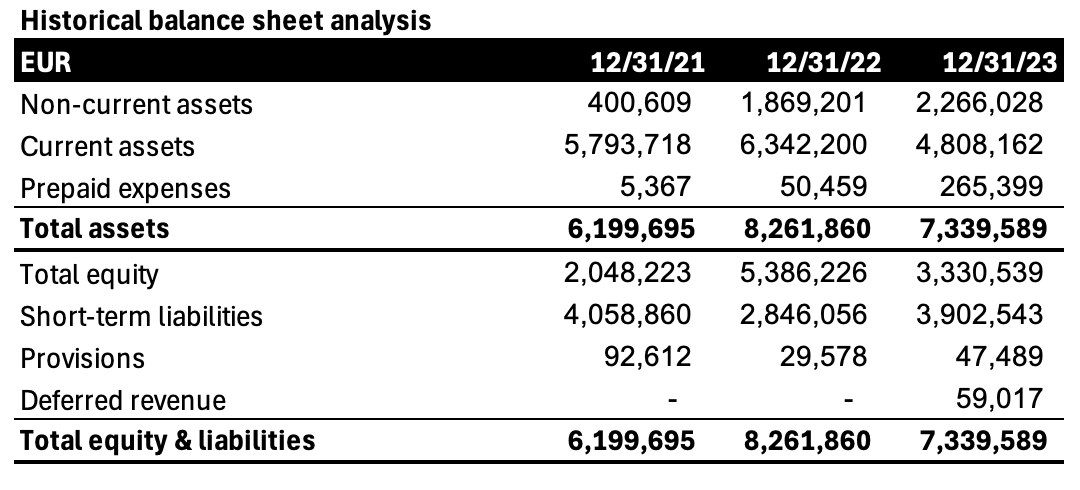
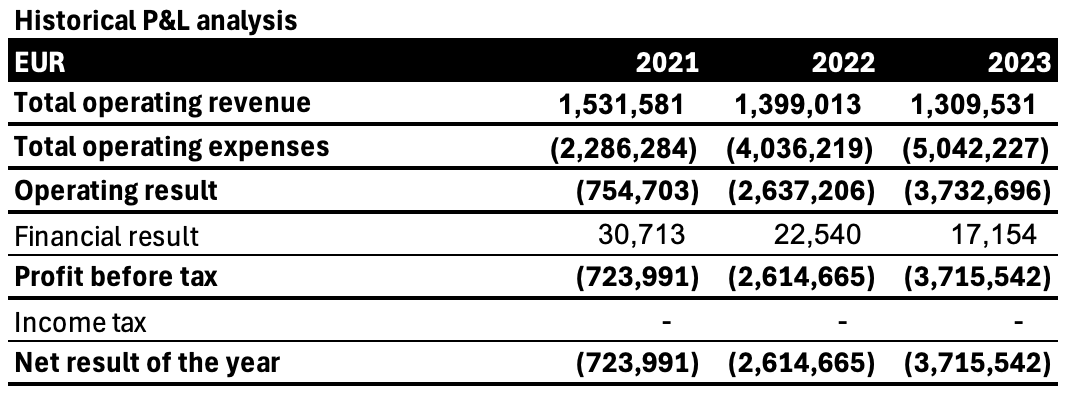
Income statement During the historical period analysed (i.e. 2021-2023), the acquiring services were the one generating the main revenue of xMoney, while the issuing business has been launched only by the end of 2023 (i.e. October). From the acquiring perspective, the company’s financial performance during the last three years has been affected by the insolvency of one significant client which determined the decrease in revenue by a compounded annual rate of about 35%. In order to diversify the company’s income and to compensate for the decline in acquiring revenue, the company launched a new activity in October 2023 which is the electronic money issuance business using the e-money licence. More specifically, a EUR denominated debit card has been issued for consumers to facilitate domestic and international payments. The company’s total revenue generated during 2021-2022 has been recorded exclusively from the acquiring business, but starting with 2023, the company’s main partners supported the activity through some incentives amounting to approximately EUR 350,000, contributing to a total revenue in 2023 of EUR 1.3m. As presented in the table below, to sustain the expansion of the acquiring activity, but also to set-up the issuing project, the company’s operating expenses recorded a significant increase from EUR 0.8m to EUR 3.7m mainly related to employees and scheme costs. The personnel increased from 15 employees by the end of 2021 to 32 in 2022, reaching 37 in 2023 as a result of the need to build and prepare for go-live the debit consumer card. From the scheme cost perspective, the technical implementations required by Mastercard to launch a competitive product in the market required a significant investment in one-off fees.
Balance sheet In terms of financial position, the company’s total assets increased by 18% during 2021-2023 from EUR 6.2m to EUR 7.3 considering the consolidation of intangible asset position as several softwares were either developed internally or acquired from third parties. The software products were used as core systems for the two business lines, issuing (core banking) and acquiring (i.e. payment gateway) and the investments are expected to generate benefits during the next years as the software increased performance is expected to support a significant scale-up. Liabilities comprise trade and other short-term payables, as well as exposure to merchants and schemes. Provisions were related to an employee litigation process in 2021, while in 2022-2023 they comprised only amounts related to the employees statutory leave entitlements. In terms of debt, xMoney did not have any bank exposure during the reference period. Liabilities remained relatively stable in 2021 and 2023, however a 30% decrease could be observed in 2022 from EUR 4.0m to EUR 2.8m as the overall acquiring volumes decreased. As a result, the exposure to merchants recorded a decline from EUR 3.6m as of 31 December 2021 to EUR 2.5m as of 31 December 2022. This negative trend in terms of merchant accounts balances continued in 2023 until EUR 2.4m. However, total liabilities as of 31 December 2023 amounted to EUR 3.9m as the company started issuing electronic money to the cardholders stored on xMoney accounts in a total exposure of EUR 0.5m. Also, trade and other payables increased from EUR 265,000 by the end of 2021 to 710,000 by the end of 2023 as new suppliers were involved in providing the card issuing services. In terms of equity, total balances recorded a 62% increase during the reference period from EUR 2.0m to EUR 3.3m as the shareholders of the company injected EUR 1.3m to support the activity until reaching a self-financing point.
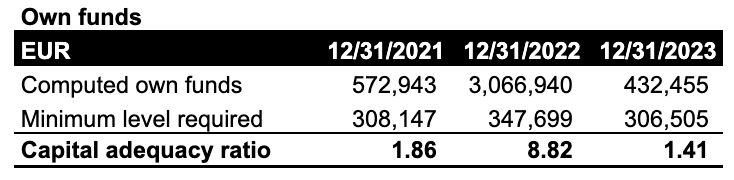
Own funds Apart from the statutory financial statements, one important key indicator for the company is the capital adequacy ratio, which was above the legal requirements each year during the historical period analysed. Capital adequacy determined as the ratio between effective own funds and required own funds evolved from 1.9 in 2021 to 8.8 in 2022 and 1.4 in 2023 as presented in the table below.
Additional details xMoney’s official currency of the financial data is RON. All the above data was converted from RON to EUR at the following exchange rates:
All the data presented in the financial condition for the past three years is based on xMoney’s financial statements, which were submitted to the fiscal authorities, Romanian Ministry of Finance, for the period 2021 - 2023. |
|||||||||
|
A.23 |
Financial condition since registration |
xMoney started its activities of issuance of USDXM on 01.06.2026. The share capital of the xMoney as of 31.10.2024 was EUR 17m. A significant share capital of EUR 6.0m has been injected during 2022 when the company has been acquired by MultiversX to cover the forecasted requirements. Subsequent capital injection of another EUR 6.2m has been recorded during 2023-2024 to support the company in developing its projects. As of December 31, 2023, the company’s financial condition was negative as a massive investment has been involved in launching a new product (i.e. xPortal debit card). The company’s treasury position by the end of the year was EUR 1.2m with no debt. |
|||||||||
|
A.24 |
Exemption from authorisation |
No |
|||||||||
|
A.25 |
E-money Token Authorisation |
xMoney is the first licensed Electronic Money Institution in Romania. License granted: 25.04.2013 License number: IEME 001 |
|||||||||
|
A.26 |
Authorisation Authority |
Banca Națională a României (BNR) |
|||||||||
|
A.27 |
Persons other than the issuer offering to the public or seeking admission to trading of the e-money token according to Article 51(1), second subparagraph, of Regulation (EU) 2023/1114 |
Not applicable. |
|||||||||
|
A.28 |
Reason for offering to the public or seeking admission to trading of the e-money token by persons referred to in Article 51(1), second subparagraph of Regulation (EU) 2023/1114 |
Not applicable. |
|||||||||
|
PARTB - INFORMATION ABOUT THE E-MONEY TOKEN |
|||||||||||
|
B.1 |
Name |
USDXM |
|||||||||
|
B.2 |
Abbreviation |
USDXM |
|||||||||
|
B.3 |
Details of all natural or legal persons involved in design and development |
|
|||||||||
|
A DESCRIPTION OF THE CHARACTERISTICS OF THE E-MONEY TOKEN, INCLUDING THE DATA NECESSARY FOR CLASSIFICATION OF THE CRYPTO-ASSET WHITE PAPER IN THE REGISTER REFERRED TO IN ARTICLE 109, AS SPECIFIED IN ACCORDANCE WITH PARAGRAPH 8 OF THAT ARTICLE |
|||||||||||
|
B.4 |
Type of white paper |
EMTW |
|||||||||
|
B.5 |
The type of submission |
NEWT |
|||||||||
|
B.6 |
Crypto-Asset Characteristics |
USDXM is issued as an electronic money tokenor e-money token, as defined in Art. 3.1.(7) of MiCA and is considered a type of crypto-asset that purports to maintain a stable value by referencing the value of one USD. USDXM complies with the provisions of the EU’s Markets in Crypto-Assets Regulation (EU) 2023/1114 and the E-Money Directive (2009/110/EC), aligning with financial standards in the EEA. USDXM is an e-money token issued by xMoney, an authorised electronic-money institution regulated under the Romanian laws by the National Bank of Romania. To uphold a 1:1 peg and ensure both stability and value retention, every issued USDXM will be backed by an equivalent amount held in xMoney reserves in USD. USDXM shall be fully backed by an equivalent amount of USD-denominated assets held by xMoney with regulated financial institutions. These assets shall be allocated in two distinct portions: a portion maintained in segregated accounts, held separate from xMoney's corporate funds, specifically on behalf of and for the benefit of USDXM holders, and a portion invested in secure, low-risk instruments to ensure stability. For every USDXM issued by xMoney and remaining in circulation, xMoney will maintain an equivalent amount of USD-denominated assets, either in its segregated accounts or in low-risk investments with minimal market risk. The USD reserves are subject to regular audits by the licensed third-party auditors Moore Audit Advisory SRL, ensuring accountability and transparency for all stakeholders. The reserves will be audited each year as part of the regular annual audit. |
|||||||||
|
B.7 |
Website of the issuer |
||||||||||
|
B.8 |
Starting date of offer to the public or admission to trading |
01.06.2026 |
|||||||||
|
B.9 |
Publication date |
08.12.2025 |
|||||||||
|
B.10 |
Any other services provided by the issuer |
xMoney provides other services related to e-money and debit cards for retail customers alongside payment processing services for B2B customers, in accordance with the Romanian national laws and regulations: Legea 209/2019, Legea 210/2019, National Bank of Romania Regulation no. 4/2019, National Bank of Romania Regulation no. 5/2019. |
|||||||||
|
B.11 |
Identifier of operator of the trading platform |
Not Applicable. |
|||||||||
|
B.12 |
Language or languages of the white paper |
English |
|||||||||
|
B.13 |
Digital Token Identifier Code used to uniquely identify the crypto-asset or each of the several crypto assets to which the white paper relates, where available |
Not available. |
|||||||||
|
B.14 |
Functionally Fungible Group Digital Token Identifier, where available |
Not available. |
|||||||||
|
B.15 |
Personal data flag |
Yes |
|||||||||
|
B.16 |
LEI eligibility |
Eligible |
|||||||||
|
B.17 |
Home Member State |
Romania |
|||||||||
|
B.18 |
Host Member States |
xMoney is licensed to issue, distribute and redeem electronic money in the
following countries within EEA: Croatia France Germany Iceland Latvia Slovakia Spain Sweden
|
|||||||||
|
PART C - INFORMATION ABOUT THE OFFER TO THE PUBLIC OF THE E-MONEY TOKEN OR ITS ADMISSION TO TRADING |
|||||
|
C.1 |
Public Offering or Trading |
OTPC |
|||
|
C.2 |
Number of units |
Unlike some other crypto assets, USDXMdoes not have a fixed supply limit. This means xMoney can issue as many USDXMas needed to meet demand. The total quantity of USDXMreleased by xMoney will be influenced by global demand. xMoney will meticulously monitor the remaining supply which will accurately represent the number of USDXMminted minus the number of USDXMredeemed. For a comprehensive overview of USDXMcirculation, please visit our official website at https://xmoney.com/transparency. |
|||
|
C.3 |
Trading Platforms name |
USDXM is not listed on any platforms at the date of the notification. USDXM admission to trading is sought on several global regulated crypto asset services providers operating in the EEA, such as Binance, Kraken, Bybit, OKX, MEXC, Gate.io, Bitvavo, Bitpanda. The list of the platforms will be updated here: https://xmoney.com/partners. |
|||
|
C.4 |
Trading PlatformsMarket Identifier Code (MIC) |
Not Applicable. |
|||
|
C.5 |
Applicable law |
The public offering of USDXM in the EEA is subject to Romanian laws. |
|||
|
C.6 |
Competent court |
The competent courts shall be exclusively the Romanian courts, in accordance with the Romanian laws. |
|||
|
PARTD - INFORMATION ON THE RIGHTS AND OBLIGATIONS ATTACHED TO E-MONEY TOKENS |
|||||
|
D.1 |
Holder’s rights and obligations |
The rights and obligations of the holders of USDXM tokens, arise from MiCA or the Romanian laws and are mentioned in this White Paper and in the Terms and Conditions available on the website’s legal section: https://xmoney.com/legal. Holder`s rights
The institutional/business holders, residents in the EEA, who have successfully registered with xMoney by creating an account on its platform, are entitled to exercise their right of redemption of USDXM in fiat currency (i.e. in a bank account at a credit institution) at any time, at par value, but they cannot receive electronic money issued in another form by xMoney.For more details about the redemption conditions please refer to: https://xmoney.com/legal. For this category of holders of USDXM token, the redemption is available directly through xMoney via the communication channel agreed between the parties, in maximum 7 days from the request, given that all necessary information was provided by the holders in order for xMoney to respect the regulatory impositions when a redemption request is received. xMoney will only transfer the equivalent of USDXM to a bank account held in USD, in the name of the xMoney account holder and only bank accounts within the Single Euro Payments Area (SEPA) are acceptable for transactions. For retail customers or customers outside the EEA, which do not have an account created on xMoney platform, USDXM is listed on multiple cryptocurrency service providers platforms, where the redemption can be requested. An updated list of such partners will be available on https://xmoney.com/partners. Also, retail customers can redeem the USDXM token directly from xMoney according to the Redemption Policy.
USDXM holders retain the right to access detailed information regarding the issuance, redemption, and safeguarding of the USDXM underlying reserves. Holders can trust that xMoney will maintain reserves corresponding to the circulating supply, ensuring the integrity and solvency of the system.
xMoney ensures the privacy of holders by safeguarding personal data collected during onboarding and transaction processes. All data is handled in compliance with applicable EU data protection laws.
Institutional and business USDXM holders may access xMoney’s secure platform to view their USDXM balances, initiate transactions, and manage their account information.
In the event that holders of USDXMtokens believe that their rights have been infringed or issues have arisen, they shall have the right to submit a complaint in accordance with the procedure outlined in Section D.7 of this White Paper. Additionally, if the response provided by xMoney does not satisfactorily address the concerns of the holder, such holder shall have the right to seek redress from the relevant regulatory authority, as specified in Section D.8 of this White Paper. Holder`s obligations
USDXM holders are required to undergo necessary KYC (Know Your Customer) and KYB (Know Your Business) verification processes. This includes providing valid identification documents, proof of bank account and cryptocurrency wallet ownership, and, if necessary, proof of the source of funds during issuance or redemption.
USDXM holders are required to provide accurate and up-to-date information during the onboarding/redemption process, including proof of identity, proof of address, and evidence of crypto wallet ownership, if case.
USDXM tokens must be used exclusively by the holder for legitimate purposes. The holders acknowledge that they shall hold and use USDXM solely for their own benefit and shall not act as nominees or agents of xMoney. USDXM holders may not act as intermediaries or agents on behalf of restricted persons or entities (i.e. appearing on the OFAC, UN, EU sanction lists), and any use of USDXM for unauthorized or illegal purposes is strictly prohibited. Illegal purposes include but are not limited to: illegal gambling, money laundering, fraud, terrorism financing, and other illicit activities.
Holders acknowledge that blockchain transactions are irreversible. Once stablecoins are transferred to another address, holders accept the risk of loss if the address is incorrect, inaccessible, or associated with entities that may not return the tokens. xMoney will not be liable for losses resulting from the loss or theft of private keys, unauthorized access to wallets, or errors in USDXM transfers.
Transfers to or from addresses associated with illegal activity or sanctioned entities are strictly prohibited. xMoney reserves the right to freeze USDXM or report transactions to the competent authorities if there is reasonable suspicion of illegal activity or regulatory non-compliance, or a legal order has been received from any regulatory body.
USDXM holders understand that xMoney does not grant any interest or other financial returns that are related to the period they hold USDXM. USDXM amount hold represents a digital equivalent of fiat currency and is issued and redeemed at par value without generating additional earnings for the holders.
By participating in the USDXM ecosystem, the holders agree to all the rights and obligations outlined in this section, as well as any additional terms specified in our Terms Conditions and Policies available on xMoney’s website (https://xmoney.com/legal). |
|||
|
D.2 |
Conditions of modifications of rights and obligations |
xMoney reserves the right to modify, amend, or supplement the rights and obligations of its holders at any time, and shall notify its customers of such changes through updates to this White Paper, the Redemption/Recovery Policies, or other relevant documentation published on the xMoney website (https://xmoney.com/legal), or through any other means of communication deemed valid and effective. As provided by Article 51 (12) of MiCA, any significant new factor, any material mistake or any material inaccuracy that is capable of affecting the assessment of USDXM will be described in a modified version of this White Paper drawn up by xMoney and notified to the competent authorities and published on xMoney website (https://xmoney.com/legal), provided that such modifications are not related to the implementation of xMoney`s Recovery or Redemption Plan, instance where the conditions outlined in Section D.4 and Section D.5 of this White Paper will take precedence. |
|||
|
D.3 |
Description of the rights of the holders |
For circumstances where xMoney might not be able to fulfil its obligations, including in insolvency procedures, xMoney has established and maintained robust standards to ensure the prudent and sound financial management of its operations. In the event of financial distress or insolvency, xMoney shall activate its Recovery and/or Redemption Plan to ensure that USDXM holders can exercise their redemption rights in accordance with the procedures outlined in Sections D.4 and Section D.5 below. |
|||
|
D.4 |
Rights in implementation of recovery plan |
xMoney’s Recovery Plan will be filed with the National Bank of Romania within six months of the date of the offer to the public or admission to trading as mentioned in the Article 55 of MiCA. This Section D.4 may be updated following the Recovery Plan notification. Depending on the specific circumstance(s) under which the Recovery Plan is triggered, xMoney may have to impose one or more specific restrictions on the redemption of USDXM. Holders will be duly informed about any such restrictions on xMoney’s Website. For instance, xMoney may temporarily impose:
These restrictions will be implemented during periods of market stress and xMoney will work to restore normal operating conditions subject to regulatory requirements in collaboration with the National Bank of Romania. |
|||
|
D.5 |
Rights in implementation of redemption plan |
In accordance with Article 55 of MiCA, xMoney will provide a Redemption Plan to the National Bank of Romania within six months of the date of making USDXM available in the EEA. The Redemption Plan is an operational plan to support the orderly redemption of USDXM in circulation. This section will be updated following filing of such Redemption Plan. The Redemption Plan will be triggered upon a decision by the National Bank of Romania, if xMoney is unable or likely to be unable to fulfill its obligations, including in the case of insolvency, resolution, or the withdrawal of authorisation of xMoney as an e-money institution. The processes set forth in the Redemption Plan will be established with a view of ensuring the equitable treatment of all holders and the protection of the right of redemption attached to USDXM as described above. If the National Bank of Romania triggers the implementation of the Redemption Plan, any individual claim under Section D.1 above will be suspended. Instead, xMoney will commence the orderly redemption for all token holders in an equitable manner, subject to the Redemption Plan and in collaboration with the National Bank of Romania. As part of this process, a notice will be published informing all USDXM holders about the process and timelines to submit their redemption claim. Specifically, the notice will describe the main steps of the redemption process, including the exact date and time when the redemption plan has been activated, the minimum information necessary to file a redemption claim, where the claim should be filed, and the time frame within which USDXM holders are required to file their claim. The notice will also contain important information regarding redemption conditions and technical support. Redemption requests submitted via a redemption claim form will be subject to certain eligibility criteria described in the Redemption Policy, and as further specified in the Redemption Plan notice information, including their identity, their token holdings, AML/CFT compliance, their bank account details, and other information required to file their redemption request. |
|||
|
D.6 |
Complaint Submission Contact |
complaints@xmoney.com |
|||
|
D.7 |
Complaints Handling Procedures |
To handle complaints in the best possible way, the following information will be requested:
Upon receipt of a complaint the employee involved with Customer support will:
|
|||
|
D.8 |
Dispute Resolution Mechanism |
If xMoney’s response to the initial complaint is unsatisfactory, USDXM holders and customers may choose the following dispute resolution mechanism. xMoney has established a structured and transparent dispute resolution process to ensure fair treatment of USDXM holders and efficient resolution of any concerns related to the issuance, redemption, or use of USDXM. If the USDXM holders find the initial resolution unsatisfactory, they may escalate the matter to senior management for further review. To initiate this process, the holder must formally notify the Customer support team of their intent to seek senior management’s intervention in resolving the issue. However, such a request will only be considered if the holder has first complied with the procedures outlined in Section D.7 Complaints Handling Procedures of this White Paper. Upon escalation, senior management will reassess the case and provide a final internal decision within fifteen business days. If internal efforts do not resolve the dispute to the holder’s
satisfaction, the matter may be escalated to alternative dispute resolution mechanisms such as: (1)
mediation according to the rules outlined in the Romanian Law no. 192/2006 or (2) in the case of
arbitration, the arbitrators shall be appointed by mutual agreement of the parties. In the absence of an
express agreement, the arbitrators shall be appointed in accordance with the provisions of the Romanian
Civil Procedure Code or, in the case of institutional arbitration, under the rules of the International
Commercial Arbitration Court attached to the Chamber of Commerce and Industry of Romania. The token holder may also opt to fill in a complaint with the National Authority for Consumer Protection, address: Aviatorilor Boulevard no. 72, sector 1, Bucharest, Romania, Phone: +40377 755 100, website: https://anpc.ro/en/. |
|||
|
D.9 |
Token Value Protection Schemes |
Yes |
|||
|
D.10 |
Token Value Protection Schemes Description |
USDXM will be collateralized by an equivalent amount of USD with at least 30% held in segregated accounts with regulated financial institutions. These assets are held separately from xMoney's corporate funds and are designated for the benefit of USDXM token holders. The remaining funds are invested in secure, low-risk assets that qualify as highly liquid financial instruments with minimal market risk, credit risk and concentration risk, in accordance with Article 38(1) of MiCAR and are denominated in USD. |
|||
|
D.11 |
Compensation Schemes |
No |
|||
|
D.12 |
Compensation Schemes Description |
Not applicable. |
|||
|
D.13 |
Applicable law |
Romanian law |
|||
|
D.14 |
Competent court |
The competent courts shall be exclusively the Romanian courts, in accordance with the Romanian law. |
|||
|
PARTE - INFORMATION ON THE UNDERLYING TECHNOLOGY |
|||||
|
E.1 |
Distributed ledger technology |
Distributed Ledger Technology (DLT) refers to a digital system for transaction recording in which transaction details are concurrently maintained across multiple distributed nodes. Unlike traditional centralised databases that rely on a single data repository and centralised administration, DLT operates through a decentralised network where consensus on transactions is reached via a distributed process involving multiple nodes, each holding an independent ledger copy. DLT's key advantages include enhanced transparency, robust security, improved traceability, and higher transaction efficiency. Blockchain is a prominent form of DLT distinguished by its use of a sequential chain of cryptographically linked blocks to manage records. Each block encapsulates a batch of transactions and is connected to the previous block, creating an immutable ledger; modifying any block would necessitate changes to all subsequent blocks, ensuring data integrity. Blockchains also support smart contracts, self-executing contracts embedded in code that automate and enforce predefined transaction conditions without intermediaries, streamlining processes and increasing efficiency. Furthermore, blockchains enhance consumer choice and promote interoperability. The open-source nature of blockchain code allows users to inspect, validate, and choose platforms that align with their needs, fostering transparency and informed decision-making. The standardised, permissionless architecture of blockchains enables different applications to integrate seamlessly, facilitating cross-platform interaction and driving innovation by allowing diverse services to interoperate within the blockchain ecosystem. The Integrated Blockchains employ a public, permissionless blockchain-based distributed ledger technology (DLT) that supports decentralised applications, tokens and transactions across a network of nodes. |
|||
|
E.2 |
Protocols and technical standards |
xMoney will integrate USDXM on three blockchains: SUI, MultiversX and Ethereum blockchains (`Integrated Blockchains`). xMoney will likely add additional blockchains platforms in the future. SUI blockchain employs a Layer-1 architecture with a delegated Proof-of-Stake (DPoS) consensus mechanism. SUI uses Mysticeti, a Byzantine Fault Tolerant consensus protocol based on a Directed Acyclic Graph (DAG). It builds upon the accomplishments of the Narwhal-Tusk consensus algorithm and improves upon its shortcomings. Mysticeti achieves low latency and high throughput by allowing validators to propose blocks in parallel and by optimizing the commit process to reduce message rounds. SUI employs the Coin standard, which is the technical standard used for smart contracts on SUI blockchain. MultiversX employs Adaptive State Sharding and Secure Proof of Stake (SPoS) to enhance scalability, security and decentralisation. Adaptive State Sharding dynamically adjusts shards to balance network load, while SPoS ensures fast and secure transaction processing by randomly selecting validators. These protocols support high transaction throughput with low latency. Nodes can become validators only after staking a minimum required stake in the staking smart contract, however to become active they need to provide a minimum stake determined by the open validator market, the top 3200 nodes are selected at the end of each day. The validators have to run honest nodes, otherwise their rating in the system gets depleted, which results in not selecting or even jailing those nodes. Thus Secure Proof of Stake means selecting validators not only by stake, but by rating as well. Furthermore, leaders are selected randomly at every 6 seconds to build the next block from the above-mentioned qualified set of validators. Every single block needs to be signed by at least 67% of the nodes in a defined shard in order for that block to be committed and added to the blockchain. XMoney also uses the native ESDT (electronic standard digital token) standard of MultiversX. This standard enables permissionless token transfers, composability and integration into applications, minting, burning, freezing, wiping tokens and even completely pausing all the functionalities. This standard enables the blocklisting feature as well that allows xMoney to prevent specific blockchain addresses from sending and receiving USDXM. Ethereum operates as a unified virtual computer, known as the Ethereum Virtual Machine (EVM), whose state is universally agreed upon by everyone in the Ethereum network. The protocol operates on a ERC 20 Standard used for fungible tokens. More details about Ethereum`s ERC-20 Token Standard can be found on https://ethereum.org/en/. It is important to note xMoney does not guarantee or assume responsibility for protecting against or resolving any potential issues or attacks that may affect the Integrated Blockchains. If such issues occur, it may impact the availability or functionality of services related to USDXM and in the event of any disruptions or losses resulting from these issues, xMoney will not be held liable or responsible for any damages or losses incurred. In certain situations, such as a copy or soft/hard forks of the Integrated Blockchains or the discovery of a security issue with the Integrated Blockchains, xMoney may need to temporarily suspend all activities related to USDXM (including but not limited to minting, redeeming, sending, and receiving USDXM). This suspension may last until the issue is resolved, and USDXM services can be fully restored. In the event of such scenarios, we will keep you informed through updates on our website and other official communication channels. xMoney reserves the right to transfer USDXMto a new blockchain or protocol in the future, should it deem necessary for security reasons or otherwise. We will notify you through our website or other official communication channels in advance, providing ample opportunity to migrate your USDXMto the updated list of Integrated Blockchains. Please note that xMoney will not be held liable or responsible for any damages, losses, or expenses that may arise from your failure to migrate your USDXMto a new blockchain or protocol. This includes any unforeseen consequences, whether or not they could have been anticipated by xMoney or any other interested parties. We encourage you to stay informed about any updates regarding USDXMand take necessary steps to ensure a smooth transition to the new blockchain or protocol, if case. |
|||
|
E.3 |
Technology Used |
The Integrated Blockchains use consensus mechanisms to enable their decentralized network of nodes to agree on the validity and order of transactions. SUI blockchain employs a Proof-of-Stake (PoS) consensus mechanism that incentivizes validators to stake their native tokens, enhancing network security while allowing for efficient transaction validation. Unlike traditional blockchains, SUI utilizes an object-centric model that treats digital assets as independent objects, enabling parallel transaction execution. SUI blockchain leverages the Move programming language, which enhances security by ensuring that smart contracts are both safe and efficient, reducing common vulnerabilities associated with other blockchain platforms. MultiversX relies on Secure Proof-of-Stake consensus, which requires that validators stake the native token (e.g. EGLD) as collateral in order to qualify as a validator. Validators are selected for consensus based on the proportion of tokens they have staked and the rating of the nodes (automatically computed according to how well the node behaves, how many valid blocks it creates and how many valid blocks it signs), and in some cases can lose some of the staked token if they have been shown to sign invalid transactions. The Ethereum network enables the launch and operation of USDXM tokens by providing a robust blockchain infrastructure that utilizes smart contracts. These smart contracts ensure security, transparency, and programmability for issuing, holding, and transferring digital tokens. The Ethereum Virtual Machine (EVM) ensures secure execution of the smart contracts, enabling efficient token transfers, ownership management, and integration with decentralized finance (DeFi) systems. |
|||
|
E.4 |
Purchaser’s technical requirements |
xMoney mint services that allows its customers to access USDXM directly from xMoney, is currently only available to businesses/institutions located in supported jurisdictions. xMoney mint process is subject to xMoney’s Terms Conditions (https://xmoney.com/legal). The purchase of USDXM on the secondary market, for example, with EU-regulated trading platforms, is available to users of these third party platforms. Most third party trading and exchange services provided by regulated crypto-asset service providers are open to retail customers as well and subject to their own compliance and technical requirements. |
|||
|
E.5 |
Consensus Mechanism |
The Integrated Blockchains use Proof of Stake (PoS) consensus mechanisms. In SUI's Delegated Proof-of-Stake (DPoS) consensus mechanism, network participants vote to elect a limited number of validators who are responsible for creating and validating new blocks. The DPoS mechanism is used to select, incentivize, and reward honest behavior by SUI Validators and the SUI owners that stake with them. The MultiversX blockchain relies on Secure Proof-of-Stake consensus, which requires that validators stake the native token (eGLD) as collateral in order to qualify as a validator. Validators are selected for consensus based on the proportion of tokens they have staked and the rating of the nodes (automatically computed according to how well the node behaves, how many valid blocks it creates and how many valid blocks it signs), and in some cases can get jailed if they have been shown to sign invalid transactions, invalid blocks, invalid state transitions. Ethereumblockchain currently uses a Proof of Stake (PoS) consensus mechanism, where the network security and transaction validation are maintained by validators who stake the native token (ETH) as collateral. Validators are chosen to propose and validate blocks based on the amount of ETH they stake and the duration of their stake. PoS also introduces mechanisms like slashing to penalize malicious behavior, ensuring network integrity. |
|||
|
E.6 |
Incentive Mechanisms and Applicable Fees |
The Integrated Blockchains have their own incentive mechanisms for the validators and request fees to realise transactions. The SUInetwork employs a unique incentive mechanism that aligns the interests of validators, token holders, and users. Validators are incentivized to operate efficiently and set low gas prices through a DPoS system, where their rewards are tied to their performance and the amount of stake they hold. Users pay gas fees for computation and storage, which are kept predictable and low through a reference price set by validators at the start of each epoch. The gas fees consist of computation units multiplied by a reference gas price and storage units multiplied by a storage price. Additionally, users can receive storage fee rebates when they delete data, encouraging efficient data management. For more details you can refer to Sui's Incentive MechanismsandSui's Gas Pricing Mechanism.
Incentives in MultiversXare structured around staking rewards for validators and delegators, who earn EGLD tokens
based on their contributions. Transaction fees are applied to network operations, promoting long-term
sustainability. The usual transaction fee for a standard transaction is 0,0005 EGLD. Currently, xMoney does
not take additional fees on these mechanisms. More information can be found on the official
websiteMultiversX. Ethereum's mechanism involves validators staking ETH into a smart contract to secure the network. Validators are tasked with verifying transactions, occasionally proposing new blocks, and propagating them across the network. They earn rewards in ETH for successful participation. When selected, a validator creates a block by combining transactions into an execution payload and attaching consensus data. For comprehensive insights, visit theEthereum website. |
|||
|
E.7 |
Use of Distributed Ledger Technology |
No, DLT not operated by theissuer or a third-party acting on the issuer’s behalf. |
|||
|
E.8 |
DLT Functionality Description |
Not applicable. |
|||
|
E.9 |
Audit |
NO |
|||
|
E.10 |
Audit Outcome |
Not applicable
|
|||
|
G Information on the sustainability indicators in relation to adverse impact on the climate and other environment-related adverse impacts |
|||||
|
G.1 |
Adverse impacts on climate and other environment- related adverse impacts
|
xMoney, acting as an issuer of EMTs, is providing information on principal adverse impacts on the climate and other environment-related adverse impacts of the consensus mechanism used to validate transactions in USDXM and to maintain the integrity of the distributed ledger of transactions. Total energy consumption per calendar year, expressed in kilowatt-hours (kWh), for the validation of transactions and the maintenance of the integrity of the distributed ledger of transactions: 0.82027. The data is calculated and provided by CCRI (Crypto Carbon Ratings Institute: https://carbon-ratings.com/). |
|||
|
General Information |
|||||
|
S.1 Name |
Capital Financial Services S.A. |
||||
|
S.2 Relevant legal entity identifier |
Joint-stock company |
||||
|
S.3 Name of the crypto-asset |
USDXM |
||||
|
S.4 Consensus Mechanism |
The Integrated Blockchains use Proof of Stake (PoS) consensus mechanisms. In SUI's Delegated Proof-of-Stake (DPoS) consensus mechanism, network participants vote to elect a limited number of validators who are responsible for creating and validating new blocks. The DPoS mechanism is used to select, incentivize, and reward honest behavior by SUI Validators and the SUI owners that stake with them. The MultiversX blockchain relies on Secure Proof-of-Stake consensus, which requires that validators stake the native token (eGLD) as collateral in order to qualify as a validator. Validators are selected for consensus based on the proportion of tokens they have staked and the rating of the nodes (automatically computed according to how well the node behaves, how many valid blocks it creates and how many valid blocks it signs), and in some cases can get jailed if they have been shown to sign invalid transactions, invalid blocks, invalid state transitions. Ethereumblockchain currently uses a Proof of Stake (PoS) consensus mechanism, where the network security and transaction validation are maintained by validators who stake the native token (ETH) as collateral. Validators are chosen to propose and validate blocks based on the amount of ETH they stake and the duration of their stake. PoS also introduces mechanisms like slashing to penalize malicious behavior, ensuring network integrity. |
||||
|
General Information |
|||||
|
S.5 Incentive Mechanisms and Applicable Fees |
The Integrated Blockchains have their own incentive mechanisms for the validators and request fees to realise transactions. The SUInetwork employs a unique incentive mechanism that aligns the interests of validators, token holders, and users. Validators are incentivized to operate efficiently and set low gas prices through a DPoS system, where their rewards are tied to their performance and the amount of stake they hold. Users pay gas fees for computation and storage, which are kept predictable and low through a reference price set by validators at the start of each epoch. The gas fees consist of computation units multiplied by a reference gas price and storage units multiplied by a storage price. Additionally, users can receive storage fee rebates when they delete data, encouraging efficient data management. For more details you can refer to Sui's Incentive MechanismsandSui's Gas Pricing Mechanism.
Incentives in MultiversXare structured around staking rewards for validators and delegators, who earn EGLD tokens
based on their contributions. Transaction fees are applied to network operations, promoting long-term
sustainability. The usual transaction fee for a standard transaction is 0,0005 EGLD. Currently, xMoney does
not take additional fees on these mechanisms. More information can be found on the official
websiteMultiversX. Ethereum's mechanism involves validators staking ETH into a smart contract to secure the network. Validators are tasked with verifying transactions, occasionally proposing new blocks, and propagating them across the network. They earn rewards in ETH for successful participation. When selected, a validator creates a block by combining transactions into an execution payload and attaching consensus data. For comprehensive insights, visit theEthereum website.
|
||||
|
S.6 Beginning of the period to which the disclosed information relates |
2025-01-06
|
||||
|
S.7 End of period to which the disclosed information relates |
2025-01-19 |
||||
|
Mandatory key indicator of energy consumption |
|||||
|
S.8 Energy consumption |
Total energy consumption per calendar year, expressed in kilowatt-hours (kWh), for the validation of transactions and the maintenance of the integrity of the distributed ledger of transactions: 0.82027. |
||||
|
Sources and methodologies |
|||||
|
S.9 Energy consumption sources and methodologies |
Data provided by CCRI; the indicator is based on a set of assumptions and thus represents an estimate; methodology description and overview of input data, external datasets and underlying assumptions available at: http://cdn.xmoney.com/assets/USDXM-RONX-EURX-MiCA-Sustainability-Indicators-January-2025.pdf CCRI does not account for any offsetting of energy consumption or other market-based mechanisms as of today. |
||||